Principle of modular assembly of mobile seedling turnover vehicles
2026-07-25 18:41:34
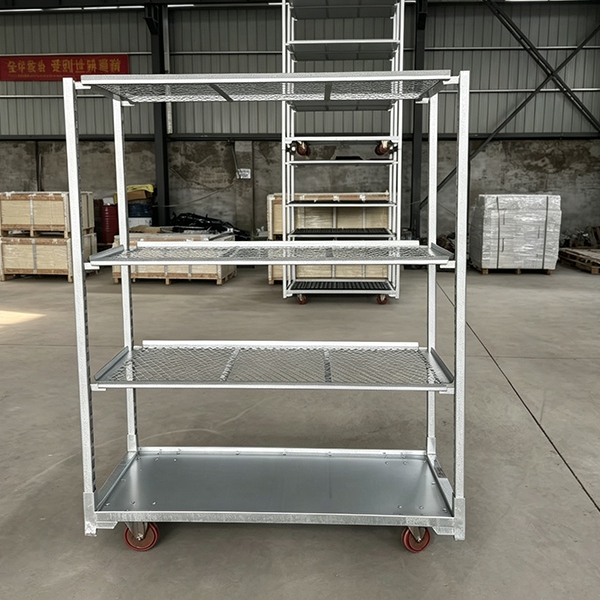
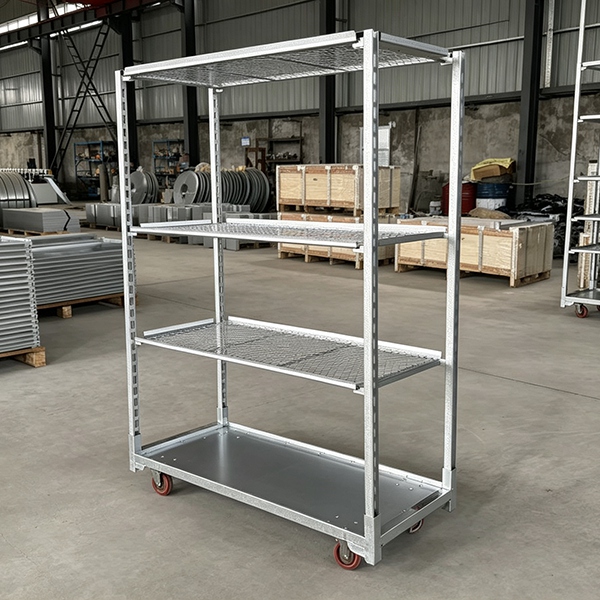
The mobile seedling turnover vehicle adopts a modular assembly structure, and the entire equipment is disassembled into independent unit components such as columns, beams, base frames, shelves, casters, and connecting accessories. All components are prefabricated and processed in the factory through cutting, punching, galvanizing, and other processes, without the need for welding on site. They rely on mechanical connecting components to complete assembly and are suitable for on-site assembly and later renovation and adjustment of greenhouses and germination bases.
The pillar is a vertical load-bearing component of the vehicle, and multiple sets of adjustable long holes are prefabricated on the surface of the profile at fixed intervals as installation points for adjusting the height of the shelf. The holes are evenly arranged vertically along the columns, providing multiple installation positions for the horizontal beams. The spacing between layers can be flexibly adjusted according to the height of the seedling tray and flower pot. The four pillars form the four corner supports of the vehicle body, which bear the vertical loads brought by the plywood and seedling materials, and maintain the stability of the overall vehicle frame shape.
The base frame is composed of horizontal and vertical crossbeams combined by bolts to form a rectangular base. The four corners of the base are reserved with caster assembly points for installing universal and directional wheels. The various profiles of the base frame are fixed by bolt locking without welding. If the base components are damaged or deformed in the later stage, they can be disassembled and replaced separately without the need to scrap the entire vehicle body. After the base is assembled, the caster components are assembled to form the foundation for the vehicle's movement and walking.
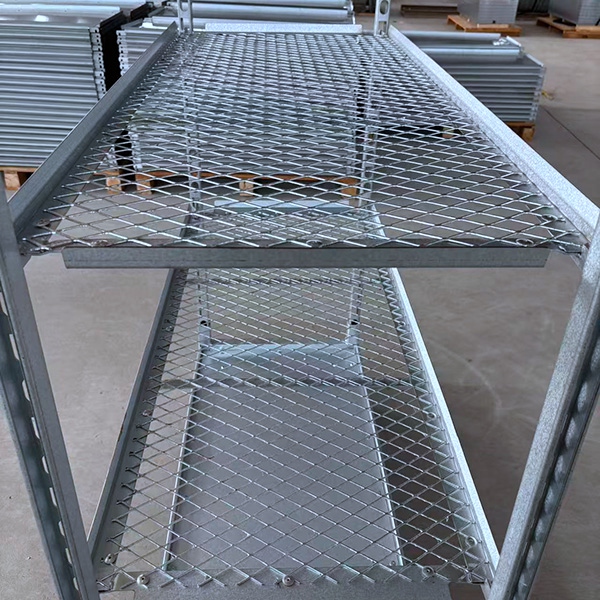
The horizontal crossbeam serves as a supporting component for the laminated board, and assembly holes are set at both ends of the crossbeam to fit the column holes. During assembly, clamp the two ends of the crossbeam against the side of the column, and lock the bolt through the column adjustment hole and the crossbeam hole to complete the construction of the single-layer support frame. By using adjustment holes of different heights on the columns, the installation height of the crossbeam can be changed to achieve interlayer spacing adjustment. The crossbeam provides uniform support for the laminated board and disperses the weight of the material borne by the laminated board.
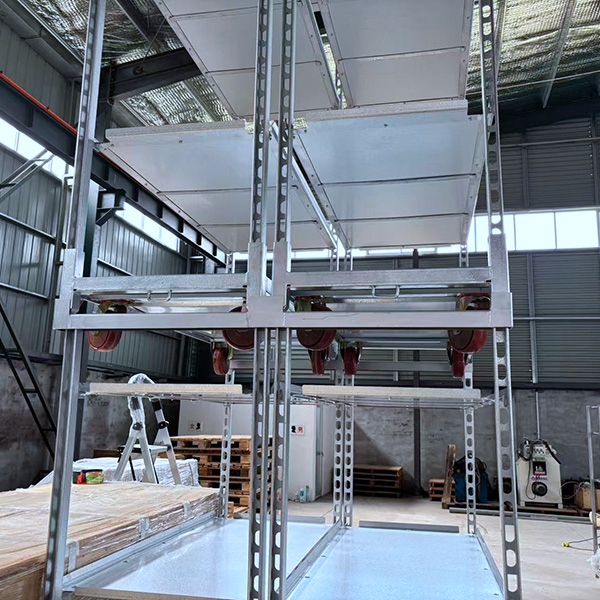
The laminated board is an independent modular component that is directly placed on the corresponding height of the crossbeam bracket, and is generally not locked or fixed. It is convenient to increase or decrease the number of shelves at any time according to the homework requirements. During the idle stage, the lower shelves can be directly taken, and the frames can be nested and stacked for storage, reducing the storage space occupied. Solid board, punched board, and grid board of different styles can be interchanged and used on the same frame.
The entire assembly relies on standard universal accessories such as bolts and washers to complete the assembly. The positioning between components is achieved through hole alignment, without the need for on-site drilling, cutting, or welding. The components have interchangeable properties, and the column, crossbeam, and layer accessories of the same specification turnover vehicle can be used interchangeably. The on-site assembly is completed in the order of base assembly, vertical column erection, layered installation of crossbeams, placement of shelves, and assembly of casters.
The modular structure is not only convenient for initial assembly, but also suitable for later project adjustments. The production mode of the base has changed, and the number of layers and interlayer spacing can be adjusted; The transportation process can be fully divided into individual packaging, compressing the packaging volume, improving the utilization rate of container loading, and adapting to domestic projects and foreign trade export orders. Local component damage may occur during daily use, and replacement parts can be purchased separately to reduce equipment maintenance costs.
1、 Product Overview: The partition pull plate net seedling cart is a multi-layer turnover...
1、 Product Overview: The partition pull plate net seedling cart is a multi-layer turnover...
1、 Product Overview: The partition pull plate net seedling cart is a multi-layer turnover...
1、 Product Overview: The partition pull plate net seedling cart is a multi-layer turnover...